Pages

Category

Techno (122) Gadget (84) Komputer (81) Smartphone (76) Internet (74) Tips dan Trik Komputer (64) Pernak pernik (57) Android (51) Facebook (25) Softwear (22) Computer Virus (20) Game (18) Antivirus (15) Job Application (15) Symbian (15) sex (15) Movie (14) Berita Unik (13) Kesehatan (11) Hardwear (4) BlackBerry (3) Gosip (2) Camfrog (1) Hukum (1) humor (1)
Showing posts with label Antivirus. Show all posts

Thursday, November 24, 2011

Chimo NgeBlog : The Difference Between Computer virus, Worm, Spyware, Trojan viruses, Adware and spyware

Computer virus propagates in to other files through affixing itself in to computer. It needs a carrier to get involved with computer as well as harms other files.
Earthworm has an ability to duplicate as well as sends itself in to other computer through e-mail, this can mejor antispyware not really spread in to other file however harm system rather.
Trojan could not spread in to other file, could not transmit itself in to other computer however fools a user to obtain this to set in to computer. Because Trojan offers installed, it’s incontrollable. There are lots of kinds of Trojans.
Spyware will not spread in to other file, not really transmit itself in to other computer, however fools a user to obtain this in to computer or by a space of internet browser to install as well as infringe a owner’s privateness.
Hybrid Malware/Blended Threats is actually Malware which includes all the capability of Computer virus, Earthworm, Trojan as well as Spyware together.
Phishing is a technique of creating a social engineering by using e-mail to fool person to reveal financial statement such as credit card or online bank account.
Zombie Network Numerous computer systems that become a victim of Earthworm, Trojan and other Pasos Para Eliminar Un Spyware Malware will be utilized by attacker/hacker to be an address for delivering junk e-mail mail, phishing, DOS or even to maintain a few unlawful software within.
Malware has an abbreviation from Malicious Software means all programs that have aggressive in the direction of to computer as well as system, or it could be a name to call a good ill aim of plan such as Computer virus, Earthworm, Trojan, Spyware, Keylogger, Crack Tool, Dialer, Phishing, Plugin, BHO, etc.
Owing to Computer virus may be the very first Malware that occurs as well as understands for very long so, a few information or an informal article that’s much less stressed uses this particular word “Virus” instead of “Malware” In the fact, this is wrong. Anyhow each Malware is actually distinction.
Buy online with online coupons as well as special offers, save up your money. Discovering Que Es Un Malware low cost from as well as much deeper discount rates. is among the web site that offers lots of special web protection discount which will help guide you towards the the most suitable plan to safe your pc.
READ MORE - Chimo NgeBlog : The Difference Between Computer virus, Worm, Spyware, Trojan viruses, Adware and spyware

Thursday, August 18, 2011

Chimo NgeBlog : McAfee WaveSecure security app now available for iOS devices


Major antivirus firms have noted that mobile is the wave of the future, and the latest to join the group is McAfee. Although McAfee has had a version of WaveSecure on Android for some time, this is the first time consumers will have an opportunity to get McAfee security on iOS.

The new WaveSecure iOS Edition is $19.95, and is available from the iTunes store. Corporate iPhone users have already had access to McAfee's security technology via its Enterprise Mobility Manager software.

WaveSecure requires iOS 4.0 or greater. With it, an iPhone user can wirelessly back up his contacts, photos and videos from the iPhone, as well as track his device's location, with or without GPS enabled, through the McAfee WaveSecure online portal.

Advertisement

Nicely, if you were to lose your iDevice and (iDevices users would say) went to Android for a replacement, you could sync your data back to the Android device using the Android version of WaveSecure.

More security software companies are seeing the "gold" that is mobile, and adding security offerings for those platforms. Symantec recently saw the Android version of its mobile security app, Norton Mobile Security Lite, exit beta.

McAfee's move of making the app sell for a one-time fee is a bit unusual. Companies like Lookout and Symantec, as well, often give the app away for free, but charge a subscription for an enhanced feature set.

The subscription model is common in desktop security, as well.

McAfee acquired the WaveSecure technology when it bought tenCube, the creator of WaveSecure, a year ago. Also about a year ago, Intel announced it had acquired McAfee.

Source : http://www.examiner.com/technology-in-national/mcafee-wavesecure-security-app-now-available-for-ios-devices


READ MORE - Chimo NgeBlog : McAfee WaveSecure security app now available for iOS devices

Tuesday, August 16, 2011

Chimo NgeBlog : SSDownloader: 50 security apps in just a few clicks


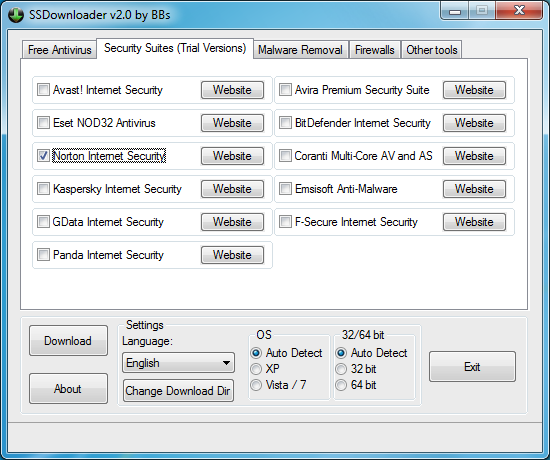
Your friend's PC has been hit by malware, and you're trying to help him out. He doesn't have any security apps installed, though, and so normally that means a lengthy browsing session around your preferred vendors, locating and downloading the tools they need.Unless, that is, you've a copy of the free, portable SSDownloader to hand. It's a small and easy-to-use download manager that can grab your choice of 50 security applications in just a few clicks.

The program presents its applications in well-organised tabs. If you're looking for an antivirus tool, say, just click the Free Antivirus tab, check the box next to your choice of engine (Avast!, AVG, Comodo, Avira, Microsoft or Panda), and click Download. SSDownloader will then figure out the file you need (XP or Windows Vista/ 7, 32 or 64-bit) and grab a copy for you.

Other tabs provide support for downloading all the main firewalls (Comodo, ZoneAlarm, Online Armor, OutPost and more) and malware removal tools (Malwarebytes, SuperAntiSpyware, HiJack This, Spybot -- Search and Destroy, and so on). An "Other Tools" tab includes useful accessories and diagnostic utilities (AutoRuns, Process Explorer). And if the free tools simply aren't enough, then there's also support for downloading your selection of eleven security suites (Avast!, Avira, BitDefender, Norton, Kaspersky, F-Secure and more).

SSDownloader isn't trying to do anything too clever. It won't attempt to install the applications it downloads, for instance; that's your job. And it doesn't check your system to see what's installed, or alert you to any updates. This is just about downloading the setup files you choose, and nothing more.

If you regularly work with new or poorly equipped PCs, though, SSDownloader has more than enough power to save you plenty of time and hassle, and it's the perfect candidate for a place in your portable troubleshooting toolkit.


READ MORE - Chimo NgeBlog : SSDownloader: 50 security apps in just a few clicks

Monday, August 15, 2011

Chimo NgeBlog : Norton Mobile Security Lite


Symantec today announced the release of Norton Mobile Security Lite (free), a simple antivirus and anti-theft product for Android. Today also marks the release of Norton Mobile Security 2.0 from beta testing.

Norton Mobile Security Lite offers exactly the same antivirus Android-specific protection as the non-Lite edition. It scans all files and updates downloaded to your phone and automatically removes any threats. LiveUpdate ensures that malware definitions remain up to date. It refrains from updating while you're roaming, to avoid unnecessary data charges. Naturally you can launch a manual scan at any time.

In the event your smartphone is lost or stolen, you can use Norton Mobile Security Lite to lock it, so a thief can't also steal your data. That's the extent of the free edition's features. If you want the ability to wipe or locate the phone remotely or require a password before allowing the SIM card to be changed, you'll need to update to the full product. Kaspersky Tablet Security also offers antivirus protection, but without remote locking or any phone-specific features.

Specifications

Type
Business, Personal, Professional
Free
Yes
Tech Support
Forum-based support.
More

The non-Lite edition includes a number of other features such as phishing protection. If you browse to a fraudulent site on your mobile phone, it will warn you. Webroot Mobile Security for Android offers a similar feature to keep you away from malicious sites, while Trend Micro Mobile Security for Android blocks both malicious and phishing sites.

The full, paid edition also can block unwanted phone calls or texts. Users can review the call log or SMS log to choose numbers that should be blocked. A prominent "Upgrade to Full Version" button allows users to pay and perform the upgrade from within the free edition.

Norton Mobile Security Lite is available as a free download from the Android Market.


READ MORE - Chimo NgeBlog : Norton Mobile Security Lite

Saturday, July 16, 2011

Chimo NgeBlog : Does iOS Need Antivirus Protection?


By now, security-conscious IT pros know about the new and improved version of the iOS jailbreaking software, jailbreakme, now with iPad 2 support. It ingeniously exploits a flaw in the iOS PDF display code to, via a buffer overrun attack, load jailbreak code into the root file system of the device. Once rebooted, the hacked code injects itself into the device's startup sequence using the video frame buffer as its temporary scratch memory.

What makes this exploit so nefarious is not only its device-independence (it works on everything from the original iPhone and iPad Touch to the latest iPad 2), but that it uses innocuous-looking PDF files, delivered via the browser using Safari's built-in PDF viewer, as its distribution method. While jailbreakers generally know what they're getting into, the same technique could be used more deviously by those with less wholesome intentions to deliver "modified" PDF files via obfuscated URL shortening and a Twitter or Facebook feed. While the specific PDF vulnerability has not been publicly identified, and the current exploit isn't known to have a malicious payload, the technique could easily be used for more nefarious purposes than jailbreaking. As a posting on F-Secure's blog points out:

So, although the intent and results of this hack appear to be relatively benign (and reversible), it's still interesting and disturbing because of its technique -- an app running in user space that can inject code into the device's root file system -- and distribution method -- untethered, wireless browsing to a site with the malicious payload versus Apple's standard method for kernel modifications using iTunes and DFU (device firmware update) mode. Of course, Apple promises a patch for this iOS vulnerability, and based on the last time this PDF vulnerability was exploited (August), the fix will likely be quick in coming, perhaps even by the time you read this.

However, this incident raises a larger issue: What should Apple's (or any mobile device vendor's) strategy be toward security? While iOS incorporates many security techniques not seen in the more open PC environment, including a tightly controlled, curated application ecosystem, this incident clearly demonstrates that it's still not immune to serious security holes. Since we're on the third iteration of this particular exploit, I'm wondering if Apple should do more than play whack-a-mole, issuing iOS patches in response to the latest hack.

Sure, the reactive approach is the norm; witness Microsoft's monthly Patch Tuesday releases to fix the endless stream of discovered Windows holes. But Apple's tight control of the iOS application ecosystem also means it's impossible for third parties to produce antivirus/anti-malware software. There are too many restrictions on what legitimate applications can do within iOS, such as scanning another app's memory or local storage, to allow traditional A/V techniques to work.

Of course, this is a blessing and a curse. Such tight control over an application's access to the rest of the system is a cornerstone of the iOS security model. However, it also means the security onus is entirely on Apple. Android's more open approach enables third-party security apps, such as AVG, Lookout, and Symantec, to augment native runtime protections built in to the OS with code-scanning and data-protecting features that arguably can catch (or mitigate) zero-day -- read: unpatched -- exploits. Still, I'm not sure which model will work best on mobile devices: Apple's tightly controlled, IBM-mainframe approach or Android's freewheeling, all-comers, Microsoft PC-like paradigm.

READ MORE - Chimo NgeBlog : Does iOS Need Antivirus Protection?

Monday, July 11, 2011

New Botnet Is "Practically Indestructible"


Researchers working for antivirus firm Kapersky Labs have discovered a new botnet so cleverly constructed that it has been dubbed "practically indestructible."

Before you start harumphing and reminiscing about the old days when tech geeks couldn't even define "hyperbole," much less spout the stuff like the biggest geyser ever, hear them out. This thing is just devious.

Dubbed "TDL-4" -- they've got hyperbole down, and that's the best name they could come up with? -- the new botnet is reportedly already infecting 4.5 million Windows PCs worldwide. The botnet's owners use public peer-to-peer filesharing networks to transmit information to the system, and all such transmissions are encrypted with a custom algorithm.

The really insidious bit is what the TDL-4 code (it calls itself "Top Bot") does once it gets into your computer. Instead of installing itself to C: like any respectable program, the code takes root in the computer's boot record. That screen that shows up before Windows actually loads? In essence, that's where Top Bot lives. This makes it nearly undetectable by the vast majority of antivirus software, and since it activates prior to Windows even coming online, Microsoft's flagship operating system has no power over it.

This also means that formatting your computer, a process that restores every Windows component to its most basic state, has no effect on Top Bot.

Not content to simply make your computer a slave to its illicit masters, Top Bot also goes after other malware. The logic, New Scientist points out, is that a user might notice if a half dozen viruses were bogging their computer down. That's attention that Top Bot doesn't want to attract, so it's programmed to reroute the outgoing communications of 20 common malware programs, effectively rendering them inert.

As with the vast majority of these sorts of botnets, researchers claim the system is most likely used to generate spam email and aid in a wide range of online attacks.

On the one hand, the words "nefarious" and "insidious" come to mind in regards to this thing's ability to infect new hosts. On the other hand, I'm almost impressed by the clever technological design in place here.

I guess that's like Bishop praising the xenomorphs in Aliens. Analytically, I can see that they're a fascinating example of adaptive evolution, but that doesn't do much for John Hurt's burst ribcage.

READ MORE - New Botnet Is "Practically Indestructible"

Sunday, July 10, 2011

Fake AV Security Tool Windows


US situated Enigma Software Group an organization which deals with Internet security analysis says that one more fake anti-virus named 'XP Antivirus 2012' is doing the rounds on the Net.

Elaborating on the software, the security company says that it isn't software for safeguarding a user's computer from spyware or virus infections rather it's a piece of malware itself, which constantly alters its name. Indeed, XP Antivirus 2012 is like a well-known malicious anti-spyware similar to Vista Anti-virus 2012, XP Security 2012, Win 7 Security 2012 and Vista Security 2012 that are already into existence in the wild.

In particular, Enigma cautions that end-users mustn't rely on XP Antivirus 2012 since it's a creation of pretty advanced hackers and scammers.

The company further observes that operators of computer systems who may've come across XP Antivirus 2012 must have realized firsthand the extent to which this software causes annoyance and deception.

Specifically, anyone contaminated with this fake AV, doesn't just get irritating and misleading pop-up warnings as well as false results from system scan, but also threats of the fabricated problems utilized as a scare trick for defrauding them into parting with their money in a related scam, by buying a complete edition of XP Antivirus 2012.

Essentially, the rogue program doesn't simply exhibit alerts and system scanners it as well disrupts the user's Operating System from functioning. Accordingly, it repeatedly interrupts the computer's work as well as weakens its user's privacy. Occasionally, the malicious product may even allow additional PC worms to infiltrate the already contaminated system.

Nevertheless, whether the XP Antivirus 2012 edition is licensed or unlicensed, it never actually cleanses a computer off any malicious program. Therefore, PC operators are recommended that they shouldn't spend any money for the software.

Besides, for further remaining safe from this fake application, specialists on Internet safety observe that another anti-virus application which's genuine must be installed for removing and substituting the XP Antivirus 2012. . If this isn't done, it may endanger end-users' PCs. In addition, the specialists advise end-users for exercising utter caution while going to unfamiliar websites or loading fresh unknown applications.

READ MORE - Fake AV Security Tool Windows

Saturday, July 9, 2011

Vietnam’s anti-virus software enter the world’s top three

VietNamNet Bridge – According to the latest test of the UK’s Virus Bulletin laboratory, Vietnam’s Bkav has become one of the three best anti-virus software products in the world.


Virus Bulletin’s tests focused on the ability to recognize virus with sample virus of RAP, Wildlist, Trojans, Polymorphic, Worms and Bots.

The Bach Khoa Network Security Company’s Bkav Pro 2011 recorded high marks. It detected 100 percent of Wildlist, 100 percent of Polymorphic, 98.8 percent of Trojans, 99.81 percent of Worms and Bots and 98.1 percent of RAP virus.

RAP is a very important criterion among them and Bkav ranks third of 43 antivirus software products tested this time, higher than Kaspersky with 94.2%, AVG 94.4 percent and Avira 93.7 percent.

Vu Ngoc Son, head of Bkav Research and Development Department, said that software users have contributed highly to this success through their comments on the product.

In late 2010, Bkav entered the top ten anti-virus software products tested by the Virus Bulletin for the first time.

Virus Bulletin is a highly reputed anti-virus software verification firm in the world.
READ MORE - Vietnam’s anti-virus software enter the world’s top three

Friday, July 8, 2011

Protect Your Computer Against Summer Threats

VASCO Data Security Inc. (Nasdaq: VDSI; www.vasco.com ), a leading software security company specializing in authentication products, today announces the results of its aXsGUARD Gatekeeper Internet Threat Survey. 400 small and medium enterprises with 5 to 250 internet users were surveyed during 2010. The survey focused on mail and web traffic. The main conclusion is that, starting from September, a tremendous decline in the number of rejected and SPAM mails can be noticed. The blocking of three major worldwide botnets can explain this relapse.

A botnet is an accumulation of infected computers or bots that have been taken over by hackers – so called bot herders. Generally, the computers connected in a botnet are infected by a virus, such as a Trojan horse or a computer worm. Trojan horses are destructive programmes masqueraded as benign software applications. However, they can allow a hacker remote access to a target computer system, so that he can execute various operations, such as data theft, downloading or uploading files or adding the computer to the malicious botnet. Computer worms are a type of malware that multiplies itself and uses the computer network to spread the copies of themselves. The term botnet is often associated with the performance of malicious tasks or functions. The bot herder can control the botnet from a distance and cause damage at the moment he himself decides to.

In 2010, 3 large botnets were active on the world wide web. The results of the aXsGUARD survey 2010 show a growing amount of rejected mails during the year, with a peak in August of more than 97 million. Also, the spam that was found on mails from non-blacklisted servers peaked with 31.22%. In September, the first major botnet was blocked, which can be noticed in the relapse to 75 million mails and 21.64% SPAM. Two other botnets were rounded up in November and December, which led to respective 53 and 39 million rejected mails – a staggering decline of 60% - and 20.40% resp. 11.00% SPAM mails.

Traditionally, rejected mails and SPAM mails come to a head in the summer months. People have more time to surf on the internet and companies are not as vigilant about the internet use of their employees. Moreover, in July and August, students have more time than during the year. It is suspected that there is a connection between the students' spare time and the number of viruses and botnets developed in the summer months.

With the summer months coming closer, VASCO advises the internet user some measures for a better 'internet hygiene':

  • Install a reliable firewall. Vulnerable services are suppressed by a firewall, so your network is protected against outside attacks.
  • Make sure your anti-virus software is up-to-date. This software averts, traces and removes malware, for instance computer worms or Trojan horses. With so many different viruses swerving around, a good anti-virus would be no luxury.
  • Do not open attachments in mails from senders you do not know. After all, it must be clear that not every internet user has good intentions.
  • Surf with common sense. Avoid websites and doings of which you imagine they can cause harm.

"With these figures, we want to make all internet users attentive to the vulnerabilities on the internet, both for companies and for end-users. In holiday periods, certain companies are less vigilant and not always aware that a lot of damage can be caused by not taking evident security measures into account. We'd like to encourage end-users to urge their banks and applications providers to install better security and strong authentication," explains Jan Valcke, President and COO at VASCO Data Security. "We therefore stress the importance of automatic solutions that help companies protect their safety on the internet. aXsGUARD Gatekeeper provides different modules such as VPN, firewall, anti-virus, hacker detection and content scanning, helping companies to keep virtual vermin out."

About VASCO

VASCO is a leading supplier of strong authentication and e-signature solutions and services specializing in Internet security applications and transactions. VASCO has positioned itself as a global software company for Internet security serving a customer base of approximately 10,000 companies in more than 100 countries, including more than 1,700 international financial institutions. VASCO's prime markets are the financial sector, enterprise security, e-commerce and e-government.

Forward Looking Statements:

Statements made in this news release that relate to future plans, events or performances are forward-looking statements. These forward-looking statements (1) are identified by use of terms and phrases such as "expect", "believe", "will", "anticipate", "emerging", "intend", "plan", "could", "may", "estimate", "should", "objective" and "goal", "possible", "potential", and similar words and expressions, but such words and phrases are not the exclusive means of identifying them, and (2) are subject to risks and uncertainties and represent our present expectations or beliefs concerning future events. VASCO cautions that the forward-looking statements are qualified by important factors that could cause actual results to differ materially from those in the forward-looking statements. These risks, uncertainties and other factors have been described in greater detail in the Annual Report on Form 10-K for the fiscal year ended December 31, 2009 filed with the Securities and Exchange Commission and include, but are not limited to, (a) risks of general market conditions, including currency fluctuations and the uncertainties in world economic and financial markets, (b) risks inherent to the computer and network security industry, including rapidly changing technology, evolving industry standards, increasing numbers of patent infringement claims, changes in customer requirements, price competitive bidding, and changing government regulations, and (c) risks specific to VASCO, including, demand for our products and services, competition from more established firms and others, pressures on price levels and our historical dependence on relatively few products, certain suppliers and certain key customers. Reference is made to VASCO's public filings with the U.S. Securities and Exchange Commission for further information regarding VASCO and its operations.

This document may contain trademarks of VASCO Data Security International, Inc. and its subsidiaries, including VASCO, the VASCO "V" design, DIGIPASS, VACMAN, aXsGUARD and IDENTIKEY

READ MORE - Protect Your Computer Against Summer Threats

Tuesday, July 5, 2011

Norton Antivirus 2011 Review


Norton AntiVirus 2011 is a spectacular safety solution, providing an entire selection of effective features along with a completely new method to online security. Among the finest antivirus program obtainable, Norton AntiVirus continues to strengthen their program, and in turn- boost your current protection. Together with ongoing development as well as efficient implementation, the 2011 sequel ought to keep Norton buyers satisfied.

Symantec/Norton continues to be a massive player within the antivirus industry, groundbreaking the program from the get-go. Along with global recognition comes additional critics. Norton has had to endure various complaints within years prior regarding program bloat as well as overzealous source utilization. However the past several years have flipped that criticism entirely on end, providing a new fast resolution with a look at productive resource management. Norton AntiVirus 2011 continues to be a remarkably slender and speedy software, while including several engaging features particularly designed in order to pick up the most fatal viruses.

Installing Norton AntiVirus 2011 required under 1 minute (57 seconds). As soon as you acknowledge Norton’s Terms of Use, it is off and running. Absolutely no additional user input is necessary till set up has completed. The set up process does not even need you to restart your pc – enabling you to swiftly get back to whatever you were doing. You may, on the other hand, have to restart should you uninstall the application at a later time.

The Norton AntiVirus 2011 Dashboard exhibits the existing protection condition of your pc, in addition to a great interactive chart presenting the state of network security around the world. Through here, you are able to start a fresh scan simply by clicking on the prominent Scan Now link. Norton’s Scan Now attribute allows you to execute an immediate Quick Scan or even Complete Scan to diagnose any kind of existing vulnerabilities inside your operating system or programs. A computer virus scanner won’t do buyers any good, on the other hand, if it does not keep itself up-to-date with the most recent computer virus definitions. Norton’s Pulse Update technology, launched with Norton 2009, downloads fresh computer virus definitions nearly as soon as they’re submitted by Symantec, ensuring that your scans are working with the most up-to-date knowledgebase.

The Dashboard is filled with additional protection as well as overall performance capabilities. The Quarantine link exhibits any kind of files as well as programs that have been recognized as being possibly harmful. Clicking on the Performance link calls in the System Insight screen, which in turn displays the existing overall performance of your system. Should your system’s performance degrades, System Insight will recognize the newest activities that most likely led to the drop-off.

Outside of virus scanning, Norton offers a Reputation Dependent Scan, which in turn reviews all installed applications and running processes in your machine and recognizes those with the lowest consumer age as well as prevalence. Along with Facebook Wall Scan, you are able to request Norton to confirm that none of the links in your Facebook Wall point to known harmful websites.

Norton AntiVirus is undoubtedly effective at safeguarding your pc; right now more-so than ever before. AntiVirus 2011 is outfitted to protect your pc from viruses, Trojans, worms, bots, spyware, rootkits, hackers, as well as other malware threats, whether or not they’re online or perhaps within e-mails or even IM messages. The standard virus detection approach to coordinating signatures is powerful, and continually updated to safeguard your pc. Innovative heuristic detection is just about the standard in antivirus software, and Norton does a fantastic job of proactively examining data files as well as their behavior to halt suspicious malware. But the technologies which directly addresses the most recent threats is the reputation scanning.

Norton’s antivirus software program is effective, and specialized testing organizations agree. Norton continues to be acknowledged as probably the most effective antivirus software obtainable, and with their focus on swiftness and effectiveness, they’re also ranked among the quickest. Let’s just point out that with the 2011 edition you don’t need to choose between effectiveness and performance; with Norton AntiVirus you receive strength, speed, and security.

Norton AntiVirus 2011 sports a notable Help link in its dashboard. Using this menu you can view static help, examine tutorials, search for a release update to Norton AntiVirus, or even obtain support straight from Symantec. Norton’s One Click Support executes a rapid scan of your respective pc for recognized problems prior to getting you in touch with a Symantec adviser. You may also search the Knowledgebase directly from your Norton 2011 software. Overall, Norton offers a variety of assistance options, nonetheless you may still find a number of reports on the internet associated with irritated Norton customers not able to obtain sufficient (free) assistance.

All round, Norton AntiVirus 2011 is among the greatest antivirus software for any customer. Over just reputation, Norton provides sturdy performance as well as protection. Norton AV 2011 possesses all of the suitable features, revolutionary technologies, and it’s simple to use. The program is easy on resources, in addition to particularly designed with regard to optimal protection.

Whether you’re searching for one of the most effective antivirus software, or just require a user friendly protection solution, Norton AntiVirus 2011 is an excellent approach to take. We were quite impressed with the overall performance along with the exciting new features.

Kyle was born in the wonderful town of Laguna Beach, CA. He is an aspiring writer and a pilot in aviation. He focuses his writings on software reviews and internet tips. He writes to share his knowledge of the internet with the world. “The internet can be a very simple thing, but it can also be very complicated,” he says. He strives by helping others understand the loop-holes of the internet and enjoys the positive feedback of his readers.

READ MORE - Norton Antivirus 2011 Review

Tuesday, June 28, 2011

Best Antivirus 2011

Antivirus is necessary to protect our computers from virus attacks the computer, where the new virus today's increasingly harmful to computer users. The virus has evolved to be attacked in our hardware and software systems. So from that choice the best antivirus which is believed capable of protecting your computer from virus attacks.

To rank the best antivirus 2011 when it was still occupied five of the world rankings:
1. Bitdefender Antivirus

PRICES AND SPECIFICATIONS:
• Price: $ 29.95
• Threat Detection: Virus, Worm, Trojan, Spyware, Malware, Rootkit.
• Additional Protection: Browser exploits, OS exploits, Keyloggers, inbound email protection, outbound email protection, instant messaging protection, p2p/file sharing, registry startup protection, dialers, backdoors, hackers, phishing, identity theft protection, adware, activex, vulnerabilities , cookies, scripts, full web protection, usb auto detect.
• Protection Technology: Virus signatures, whitelisting, heuristic, real-time.
• Supported OS: XP (32 & 64 bit), Vista (32 & 64 bit), Windows 7 (32 & 64 bit)


2. Kaspersky Antivirus

PRICES AND SPECIFICATIONS:
• Price: $ 59.95
• Threat Detection: Virus, Worm, Trojan, Spyware, Malware, Rootkit.
• Additional Protection: Browser exploits, OS exploits, Keyloggers, inbound email protection, outbound email protection, instant messaging protection, p2p/file sharing, registry startup protection, dialers, backdoors, hackers, phishing, identity theft protection, adware, activex, vulnerabilities , cookies, scripts, full web protection, usb auto detect.
• Protection Technology: Virus signatures, blacklisting, whitelisting, heuristic, real-time, network security.
• Supported OS: XP (32 & 64 bit), Vista (32 & 64 bit), Windows 7 (32 & 64 bit)

3. Webroot Antivirus

PRICES AND SPECIFICATIONS:
• Price: $ 29.95
• Threat Detection: Virus, Worm, Trojan, Spyware, Malware, Rootkit.
• Additional Protection: Browser exploits, OS exploits, Keyloggers, inbound email protection, outbound email protection, instant messaging protection, p2p/file sharing, registry startup protection, dialers, hackers, identity theft protection, adware, activex, cookies, scripts, spam .
• Protection Technology: Virus signatures, blacklisting, whitelisting, heuristic, real-time, network security.
• Supported OS: XP (32 bit), Vista (32 & 64 bit), Windows 7 (32 & 64 bit)


4. Norton Antivirus

PRICES AND SPECIFICATIONS:
• Price: $ 39.99
• Threat Detection: Virus, Worm, Trojan, Spyware, Malware, Rootkit.
• Additional Protection: Browser exploits, OS exploits, inbound email protection, outbound email protection, instant messaging protection, registry startup protection, dialers, backdoors, hackers, identity theft protection, adware, activex, vulnerabilities, scripts, full web protection, auto usb detect.
• Protection Technology: Virus signatures, blacklisting, whitelisting, heuristic, real-time, network security.
• Supported OS: XP (32 bit), Vista (32 & 64 bit), Windows 7 (32 & 64 bit)


5. AVG Antivirus

PRICES AND SPECIFICATIONS:
• Price: $ 34.99
• Threat Detection: Virus, Worm, Trojan, Spyware, Malware, Rootkit.
• Additional Protection: Browser exploits, OS exploits, Keyloggers, inbound email protection, outbound email protection, instant messaging protection, p2p / file sharing protection, registry startup protection, dialers, backdoors, hackers, phishing, identity theft protection, adware, activex, vulnerabilities, cookies, scripts, full web protection, spam, usb auto detect.
• Protection Technology: Virus signatures, blacklisting, whitelisting, heuristic, real-time, network security.
• Supported OS: XP (32 & 64 bit), Vista (32 & 64 bit), Windows 7 (32 & 64 bit
READ MORE - Best Antivirus 2011

Monday, June 27, 2011

Avast's virus lab relies on robust community

Seemingly random names are embossed on the interior glass walls of the Avast offices and conference rooms in its Prague headquarters, and the June morning light shines illuminates them from behind. Written in black, these names and the orange-colored names of cities below them are in fact the forum nicknames of the people who use Avast and the cities they originate from. It appears there are Avast users on every continent on Earth, and that, said the company's CEO Vincent Steckler, is by design.
"Two-thirds of new users come from personal recommendations," he said. "Trying to get 35 million users from direct marketing is nearly impossible, so we have to rely on the community." Originally from the United States but living in Prague since he took over as Avast's chief officer in July 2009, Steckler is a numbers man. He touts the raw numbers of Avast's achievements with a pride that most parents reserve for a straight-A report card from their kids.
He gleefully told CNET that Avast can boast 29 countries with at least 1 million active users each. He pointed to Brazil having just passed France as the country with the most Avast active users, both with 12 percent. The United States is in third with 8 percent, but that Americans lead with the most Avast paid-upgrade installs. Five percent of its actives are in Russia, which Steckler said puts the country fourth on Avast's list and gives the company more active users there than the Moscow-based Kaspersky.
"We have about 1 million users per employee," Steckler noted. Avast's Brand Manager Miroslav Jirku quipped. "This is the first marketing job in my career that I don't have a marketing budget."
A former senior vice president of sales for Symantec, the makers of Norton, Steckler said that Avast has about 20 million more active users than its nearest competitor, AVG, because "there is no difference in malware protection between free and paid."
How Avast builds protection
More so than any third-party efficacy test, Avast relies on its reputation with users to fuel its growth. On CNET's Download.com, the free version of Avast is the only program with a 4.5-star rating from readers with more than 10,000 votes. Jindrich Kubec, Avast's director of antivirus research, said that to keep individuals safe Avast must deal with the same problem that all antivirus vendors struggle with. "The one single biggest challenge is the number of samples every day. This is the biggest challenge for everyone in the industry."
Also like its competitors, Avast's detection starts with gathering threat samples. Kubec said that the company sees about 50,000 to 60,000 new virus samples per day, while Steckler added that about 15,000 of those are actually unique. The difference is that the former number is the raw raw number of virus threats detected, while the later is the number of polymorphic virus families. As the name implies, these virus families behave or look similar with only slight variations, so they are considered of the same group.
Kubec also pointed out that the "bad guys" are extremely responsive. "They have very fast reactions. It takes about three hours after a threat has been stopped for the virus maker to put out a new one," which he clarified to mean a new variant.
Avast has built about 5 million "honeypots" around the Web for picking up on threats early, and it also relies heavily on its CommunityIQ database, said Kubec. "We see hundreds of gigabytes per week in our own feeds, so we have lots of metadata and heuristics over the metadata. We have the automated way of detecting something, and we have the manual power to decide quickly," he explained in English, which is not his first language.
The honeypot attracts threats and stops them before they reach people. For example, Kubec, said, "we know that some domains are really bad, [they're] just for malware. So we have some honeypots that know the binary from that domain, and then it gets killed." He cited the CZ.CC, CO.BE, and VB.CC domains, as well as old Soviet domains .SU as notoriously sources of malware.
Most if not all major consumer security vendors manage a database like Avast's CommunityIQ, which gets its anonymously contributed security data from its users. Within the program itself, CommunityIQ uses automated processes to gather its data, mostly from the program's behavior shield and anti-rootkit modules. "Rootkits are considered the most dangerous kinds of malware and the most difficult to remove," said Ondrej Vlcek, Avast's chief technical officer. "So we struck a deal with the maker of the popular GMER to integrate it into Avast. We've developed it further," to both integrate it and make it more powerful at rootkit detection, he said.
Avast CEO Vincent Steckler. ""It's not just the community, it's the influencers with the community," he said. "If they see that you're annoying their mother or their friends, they're going to stop recommending you."
(Credit: Seth Rosenblatt/CNET)
The data that CommunityIQ gathers includes "safe" programs as well as malicious ones, Kubec said, and provides Avast with a broad base of data in exchange for securing your computer. While the "Little Brother" implications may worry some, it's clearly a trade people are willing to make. "About 60 [percent] to 80 percent [of active users] opt in to the community reporting, said Steckler, who added that CommunityIQ is an opt-out choice when you install Avast. That means that during the install, users must actively choose to remove themselves from CommunityIQ, although doing so does not decrease the level of protection that Avast provides.
Pre-processing helps Kubec's team manage the virus samples that come in. By the time that one of his analysts starts working on a sample, he said, they already know its filename and metadata. Not unlike competitor AVG, Avast's virus lab runs the sample in a virtual machine through the company's proprietary tools to get a graphical layout and entropy map of the file. From there, "we search for something rare in files," said Michal Trs, a senior virus analyst at Avast.
One of 30 analysts the company employs, all based from their Prague office, he explained his comment further by saying that he and his colleagues look for code in a file that shouldn't be there, like an executable command hidden in an image file. "It's not perfect, but it does look for the file signature for metamorphic viruses and polymorphic viruses. We know that our tool is a program that the virus is not prepared for."
After generating the entropy map and determining that a file is indeed a threat, the analyst generates a checksum for it and pushes the update to Avast's users. A checksum is a fixed number generated by a tool that essentially "fingerprints" the file. If the data inside the file changes, whether by a virus or by authorized means, the checksum changes. Similar to how the police might compare fingerprints, the checksum has proven to be an effective tool for verifying a file's contents.
Related links
• Avast to go mobile, get VPN
• How AVG keeps your computer safe
The last step, Vlcek added, is making sure the new rule is risk-free. "Before we push a rule out we test it so it doesn't hurt the user. We have seen few complaints," he commented.
The changing threatscape
Defining what constitutes a threat to a person's computer security may appear on its face to be an easy task. Perhaps it once was. Today, however, Kubec said we face a much more challenging task in figuring out what is a threat that a traditional antivirus company ought to handle. "The border of where we should interfere is very difficult, some users want more security. Some want less. It's harder to define what is a virus," he said.
The bad guys, he continued, can simply buy their way into being bad guys. "They can buy server hosting, exploit kits, hire interface designers, hire accountants...I believe that the number of people writing the malware is very low, but the number of clients buying it is very high."
Worse than that, he added, are the way that social engineering is driving creativity in newer threats. "There was a very strange kind of fraud in Slovakia, where [the people committing the fraud] were getting people to register a user name on what looked like a normal site. So you tick [the box] that you accept, and then in the TOS, in the small print it said you owe them $90 per year," he said. "They were not charging you for the software, they're charging you for the link to the software."
Jindrich Kubec, Avast's Director of Antivirus Research: "The bad guys are adopting new techniques like caching servers, and they are downloading the malware constantly so it looks it's a new version--but it's really nearly the same."
(Credit: Seth Rosenblatt/CNET)
But, Kubec says, the burden of protection should not rely on the Internet service provider. "ISPs should not alter your results, they should just deliver the data. That's what they're paid for." And search engines, like Google, he said are "good" but "too slow."
"When you see a Web-based infection, it's a chain. So should Google block the original site that has a bad iFrame on a good site? I don't know," he said, shaking his head. Kubec laid a lot of the blame on unscrupulous ad agencies that he says don't care where the ads come from, even though they are being used to deliver malware and exploit people's computers.
Vlcek explained how that works. "The JavaScript doesn't usually contain the malicious payload. Instead, it scans the computer for vulnerabilities. It looks at Java, PDFs, Flash, and it only takes one to infect the computer."
Kubec also said that, at least in Europe, people have been getting malware just from listening to music. "You can run a stand-alone music application, which displays an ad. If it hits a Java exploit, you get infected." He also criticized the blogging tool WordPress for its shared theme plug-ins, because they're often written with backdoors installed, creating yet another vector by which hackers can access your Web site.
Whatever the nature of the threat, the bottom line for Steckler is reduced to Avast's reputation. "It's not just the community, it's the influencers with the community," he said. "If they see that you're annoying their mother or their friends, they're going to stop recommending you. If we've got the choice between near-term revenue or long-term user happiness, we'll go with long-term.
READ MORE - Avast's virus lab relies on robust community

Sunday, June 26, 2011

How To Remove A Trojan Virus

Sasser is the first self-executing worm to attack the MS04-011 vulnerability announced by Microsoft in April. McAfee AVERT has raised the risk assessment to medium for W32/Sasser.worm, also known as Sasser, due to it’s prevalence in the field and it’s ability to move without the support of email, which has been the primary vehicle of delivery for most of the worms seen recently. This new worm is a self-executable program that spreads by scanning random IP addresses for exploitable systems. To date, McAfee AVERT has received several reports of the worm being stopped or infecting users on several continents, with most of the reports coming from Europe.
Sasser is a self-executing worm that spreads by exploiting the Microsoft MS04-011 vulnerability. The primary purpose of the worm seems to be to spread to as many vulnerable machines as possible by exploiting un-patched Windows systems, giving it the ability to execute without requiring any action on the part of the user. Once activated the worm copies itself to a folder in the Windows System directory and adds a registry run key to load at system start-up.
After being executed, Sasser scans random IP addresses for exploitable systems. When one is found, the worm exploits the vulnerable system by creating a script and executing it. This script instructs the target victim to download and execute the worm from the infected host. The infected host accepts this FTP traffic on TCP port 5554.
Immediate information and cure for the Sasser worm can be found online at the Network Associates McAfee AVERT site. McAfee AVERT is advising its customers to update to the 4355 DATs to stay protected.
McAfee creates computer security solutions that prevent intrusions on networks and protect computer systems from the next generation of blended attacks and threats.
READ MORE - How To Remove A Trojan Virus

Zotob Worm Virus

McAfee’s system and network protection solutions provide proactive, zero-day protection against a recent wave of threats that have been working to exploit a hole in the plug-and-play feature in the Windows operating system.
The vulnerability, termed MS05-039, was announced by Microsoft on August 9 and within five days the vulnerability had been targeted by virus writers that produced multiple variants of the ever expanding SDBot family, as well as a new family now known as Zotob. McAfee solutions were able to proactively protect McAfee’s small to large business customers prior to the release of the exploit code and without updates, thereby helping to identify and block the attacks before they could cause damage to systems and networks.
“The recent exploits targeting the MS05-039 vulnerability appear to be one of the shortest vulnerability-to-worm windows we’ve seen, even shorter than the Sasser worm, which took approximately two weeks to exploit the LSASS vulnerability,” said John Vecchi, senior product marketing manager, McAfee Inc. “McAfee’s ability to provide zero-day, out-of-the box protection before the exploit code was discovered, clearly demonstrates the company’s commitment to staying ahead of both known and unknown threats and continually keeping our customers’ systems and networks secure.”
While the recent slew of threats that started last Friday have been identified as low-risk threats by McAfee, the threats can still cause harm to organizations that don’t have proactive protection in place or who haven’t downloaded the recent Microsoft patch.
McAfee solutions, which provide protection against both known and unknown threats, were able to protect users prior to the discovery of the exploit code, demonstrating their ability to proactively protect against new exploit techniques.
McAfee Entercept, which provides host-based intrusion prevention, mitigates the threat of the worms by offering zero-day protection without the need for product updates. This out-of-the-box capability reduces the time associated with patching against the vulnerabilities and allows business users to ensure critical system security and uptime. In addition, McAfee IntruShield’s network intrusion prevention appliances provide preemptive zero- day protection against the latest Microsoft exploits. As a result, IntruShield customers were proactively protected against these new threats without signature updates. IntruShield’s proactive protection is delivered through its patented shell code detection technology, which was paramount to the product’s ability to also provide zero-day protection against the new exploit techniques last month that targeted Cisco IOS-based routers.
Additionally, both McAfee VirusScan Enterprise 8.0i, the industry’s first anti-virus software product to integrate elements of intrusion prevention and firewall technology into a single security agent, and McAfee Managed VirusScan, a Web-based solution that provides always on, automatic virus protection for smaller businesses, provide customers with proactive protection against attacks targeting the buffer overflow vulnerabilities reported in the MS05-039 vulnerability.
READ MORE - Zotob Worm Virus

Panda Cloud Antivirus 1.5 offers cloud based protection for your computer

The latest version of Panda Cloud Antivirus adds a number of new features and improvements, including faster scanning times and specific file extension checks.
It seems as though every type of software imaginable now exists in the cloud, and this is even extending to security software. Panda Cloud Antivirus has just been updated to version 1.5, offering a number of important improvements over previous releases of the program. Most of the improvements are to be found in the area of performance but there are also a few new features to look out for.
The first thing that you will notice about the updated software is that scanning times have been reduced. The fact that a great deal of processing is done on remote computers helps to take the strain off your own, and the new BackgroundScan helps to further reduce CPU usage.
When it comes to configuring scans of your system, there are new options to choose from. To help speed up files checks further, you can now opt to exclude files according to type. Panda Cloud Antivirus also offers real time protection against viruses so you do not have to rely on manual scans, and you will also be warned about malicious downloads and phishing web sites.
Existing users of Panda Cloud Antivirus will find that their software will update to the latest version automatically, but you can find out more and download a free copy of the program by paying a visit to the Panda Cloud Antivirus review page
READ MORE - Panda Cloud Antivirus 1.5 offers cloud based protection for your computer